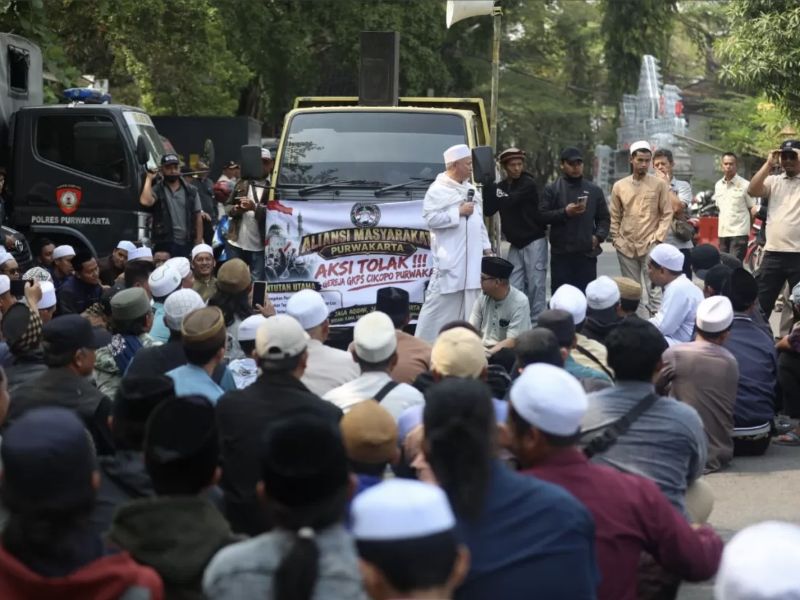
Protests Erupt Over Church Construction in Indonesia Despite Government Approval
Summary
Hundreds of residents in Cikopo Village, Purwakarta, West Java, protested the planned construction of a Simalungun Protestant Christian Church on October 20, 2026. They questioned whether community-support checks and construction requirements had been properly handled and asked authorities to review existing documents. Purwakarta Regent Saepul Bahri Binzein said the government would remain neutral and pursue dialogue. West Java’s Ministry of Human Rights said the administrative requirements were complete and emphasized that religious freedom is protected by Indonesian law. No violence or closure was reported.
Watchmen Signals
Biblical Context
Opposition to a Christian congregation’s ability to establish a church raises concerns that Scripture addresses through its teaching on hostility toward believers, lawful authority, justice, and peaceful conduct. Jesus warned His disciples that they could face opposition because they identified with Him: “If the world hates you, know that it has hated me before it hated you,” and He explained that such hostility would arise because they were not of the world (John 15:18–20). This directly relates to the reported opposition to a Protestant congregation, although the article does not establish that every resident’s objection is motivated by hatred of Christianity or that the incident constitutes severe persecution. Government officials also have a responsibility to administer law impartially and protect people from wrongdoing. Romans 13:1–4 describes civil authority as accountable to God and charged with restraining wrongdoing and promoting public order. That principle supports the regent’s stated duty to remain neutral, follow the law, and protect lawful worship while addressing legitimate administrative concerns. It does not by itself determine how Indonesian building regulations should be applied. Scripture also emphasizes impartial justice. Leviticus 19:15 commands that judgment not be perverted through partiality, and James 2:1–9 warns against showing favoritism. These passages provide a relevant ethical standard for evaluating whether a Christian congregation is being treated fairly, though they do not supply a specific legal procedure for church construction. Acts 5:29 records the apostles saying, “We must obey God rather than men,” in the context of authorities forbidding their proclamation of Christ. The passage is relevant to the importance of continued faithfulness when government directly prohibits obedience to God, but the reported dispute currently concerns permits, community support, and construction—not a stated ban on Christian worship itself. The article does not present a specific prophetic fulfillment. A local dispute over church construction does not correspond to a particular biblical prophecy, and the reported facts do not justify treating it as evidence of one.
Biblical Sources
Scripture references supporting the biblical context above.
The apostles’ statement that they must obey God rather than men applies when authorities directly prohibit obedience to God. It is only a limited comparison here because the reported dispute concerns construction and administration, not an explicit ban on worship.
James condemns favoritism and calls believers to fulfill the law of love. This principle is relevant to concerns that a Christian congregation might receive unequal treatment, though the passage does not establish that discrimination occurred here.
Jesus warned that His followers would face opposition because of their association with Him. This supports the connection between opposition to a Christian congregation and the biblical reality of hostility toward believers, while not proving that the reported residents are acting from religious hatred.
The command to judge fairly and avoid partiality provides a direct ethical standard for evaluating whether officials and community processes treat the congregation impartially.
Civil authorities are described as accountable to God and responsible for public order and justice. The passage is relevant to the government’s stated duty to remain neutral, follow the law, and protect lawful religious activity.
Comments
No comments yet.
Sign in to join the conversation.
Sign InStay Informed. Grow in Biblical Understanding.
Explore important news from around the world through the context of God's Word. Create your FREE Watchmen account to discover more news analysis, Biblical Insights, and Scripture-based perspectives.
Create Your FREE AccountFree to join. No credit card required.