Record number of Israelis join ICEJ Feast of Tabernacles celebrations
The Watchmen's Summary
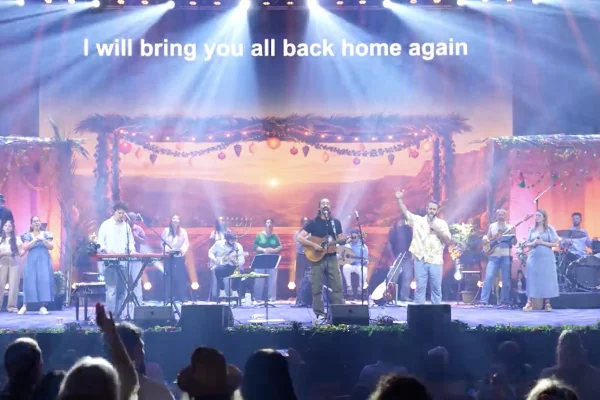
The International Christian Embassy Jerusalem held its annual Feast of Tabernacles gathering in Jerusalem during wartime, drawing thousands of international Christians and an unusually large number of local Israeli, Messianic Jewish, and Arab believers. Organizers estimated 1,500–1,800 local participants, while attendance remained below historical peaks of more than 5,000 because of COVID-19 and war. The event included worship, a desert gathering, visits to Judea and Samaria, and messages supporting Israel amid political boycotts and information warfare.
Biblical Context
The article directly concerns Sukkot, also called the Feast of Tabernacles, and describes an international Christian gathering in Jerusalem modeled in part on pilgrimage themes associated with the biblical feast. Leviticus 23:33–43 establishes the Feast of Booths and explains that Israelites were to dwell in booths as a remembrance of God bringing them out of Egypt; the article specifically quotes verses 42–43 and stages a desert gathering to recall Israel’s wilderness experience. The claim that Israel was commanded to appear before God for three annual festivals is supported by Deuteronomy 16:16–17, which identifies Passover, the Feast of Weeks, and the Feast of Booths. The article’s strongest prophetic comparison is Zechariah 14:16–19, which describes surviving nations going up to Jerusalem to worship the King and keep the Feast of Booths. The ICEJ event resembles part of that pattern because people from multiple nations gathered in Jerusalem during Sukkot. However, the article reports a contemporary Christian event, not the universal, eschatological setting and other conditions described in Zechariah 14, so it does not demonstrate fulfillment. Revelation 21:3 supports the article’s reference to the “tabernacle of God” dwelling with humanity. That passage describes God dwelling with people in the future consummation after the judgment and renewal imagery of Revelation 21. The article’s association between Sukkot and God dwelling with humanity is therefore biblically identifiable, but the present gathering should not be equated with the final reality described in Revelation.
Watchmen Signals
The article substantively concerns the biblical Feast of Tabernacles, pilgrimage to Jerusalem, Israel, the nations, and prophetic passages including Zechariah 14 and Revelation 21:3.
The international gathering in Jerusalem during Sukkot resembles Zechariah 14:16, where nations go up to Jerusalem to worship and keep the Feast of Booths. However, the article does not report the specific end-time conditions, universal participation, or post-judgment setting described in that prophecy.
This is a report about an annual religious gathering and participation levels, not a sudden event requiring prompt notification.
Biblical Sources
Scripture references supporting the biblical context above.
This passage identifies the three annual pilgrimage festivals, including the Feast of Booths, and the requirement to appear before the Lord with an offering.
This passage establishes the Feast of Booths, including the command to dwell in booths and the remembrance of Israel’s deliverance and wilderness experience, which are central to the event described.
This passage describes the future dwelling, or tabernacle, of God with humanity and supports the article’s stated theological connection between Sukkot and God dwelling with people.
This prophetic passage describes nations going up to Jerusalem to worship the King and keep the Feast of Booths, providing the specific prophetic comparison referenced by the ICEJ event.
Comments
No comments yet.
Sign in to join the conversation.
Sign InStay Informed. Grow in Biblical Understanding.
Explore important news from around the world through the context of God's Word. Create your FREE Watchmen account to discover more news analysis, Biblical Insights, and Scripture-based perspectives.
Create Your FREE AccountFree to join. No credit card required.