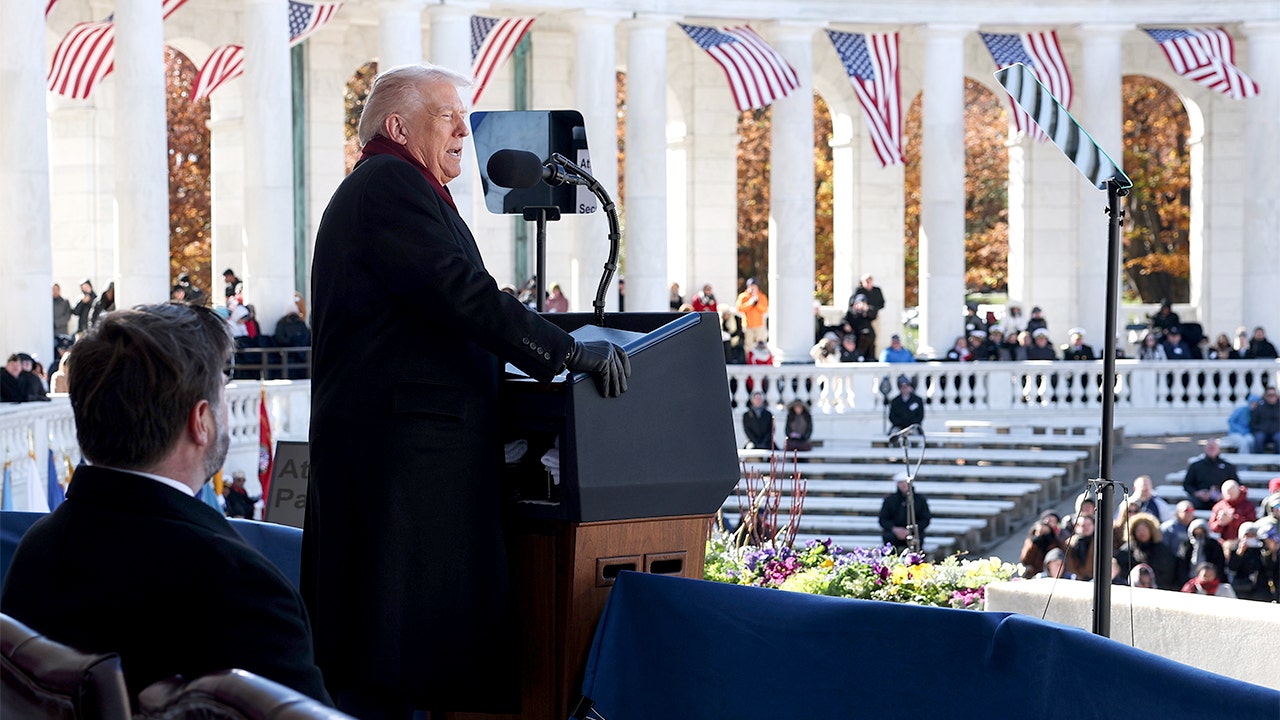
Trump defends Iran war during Veterans Day address, says he is making the world 'safer'
The Watchmen's Summary
President Donald Trump defended the ongoing U.S.–Iran conflict during a Veterans Day address at Arlington National Cemetery, arguing that Iran has waged war against America since 1979 and that the United States must achieve “total victory.” He said the conflict, lasting roughly seven months with only several weeks of active fighting, will end soon, while acknowledging 18 American deaths. Secretary of State Marco Rubio said sanctions, a naval blockade, and economic pressure are weakening Tehran, reducing the administration’s stated need for additional military strikes.
Biblical Context
The conflict raises questions about the authority and responsibility of government, the human cost of war, and the pursuit of peace. Romans 13:1–4 describes governing authorities as responsible for restraining wrongdoing and administering justice; it can illuminate the administration’s stated duty to protect Americans, while not by itself proving that a particular war or policy is justified. Jesus’ warning that nations will rise against nations in Matthew 24:6–7 places wars within the fallen realities of the present age, but it does not identify this U.S.–Iran conflict as a prophetic fulfillment. First Timothy 2:1–2 calls believers to pray for rulers so that societies may experience peace and stability, a fitting response to reported casualties, continuing hostilities, and uncertainty over how the conflict will end. These passages provide moral and pastoral context, not a biblical endorsement of the administration’s claims about victory or Iran’s intentions.
Watchmen Signals
The U.S.–Iran conflict involves war, military casualties, government authority, and the stated pursuit of a safer and more peaceful order. Scripture addresses the responsibilities of rulers, the reality of conflicts among nations, and the duty to pray for peaceful conditions, while leaving the justice and effectiveness of this particular campaign to careful evaluation.
Nothing in the reported fighting, sanctions, naval pressure, or presidential statements corresponds specifically enough to a particular biblical prophecy. Iran’s possible historical association with Persia does not, by itself, establish a connection to passages such as Ezekiel 38, and the article supplies no distinctive prophetic elements or evidence of fulfillment.
Military conflict and escalating economic and diplomatic pressure remain active, while officials discuss whether and how to end the war. However, the account describes an ongoing situation rather than a newly reported attack or sudden escalation requiring immediate notification.
Biblical Sources
Scripture references supporting the biblical context above.
Believers are urged to pray for rulers and authorities so that people may live peaceful and orderly lives, directly relating to the reported war, casualties, and uncertainty over its conclusion.
Jesus refers to wars and conflicts among nations as features of the troubled present age; the passage contextualizes the conflict without identifying it as a specific prophecy being fulfilled.
Paul describes governing authorities as responsible for administering justice and restraining wrongdoing, providing context for claims about a government’s duty to protect its people and use power responsibly.
Comments
No comments yet.
Sign in to join the conversation.
Sign InStay Informed. Grow in Biblical Understanding.
Explore important news from around the world through the context of God's Word. Create your FREE Watchmen account to discover more news analysis, Biblical Insights, and Scripture-based perspectives.
Create Your FREE AccountFree to join. No credit card required.